What a Crypto Trading Analysis App Should Do
May 16, 2026
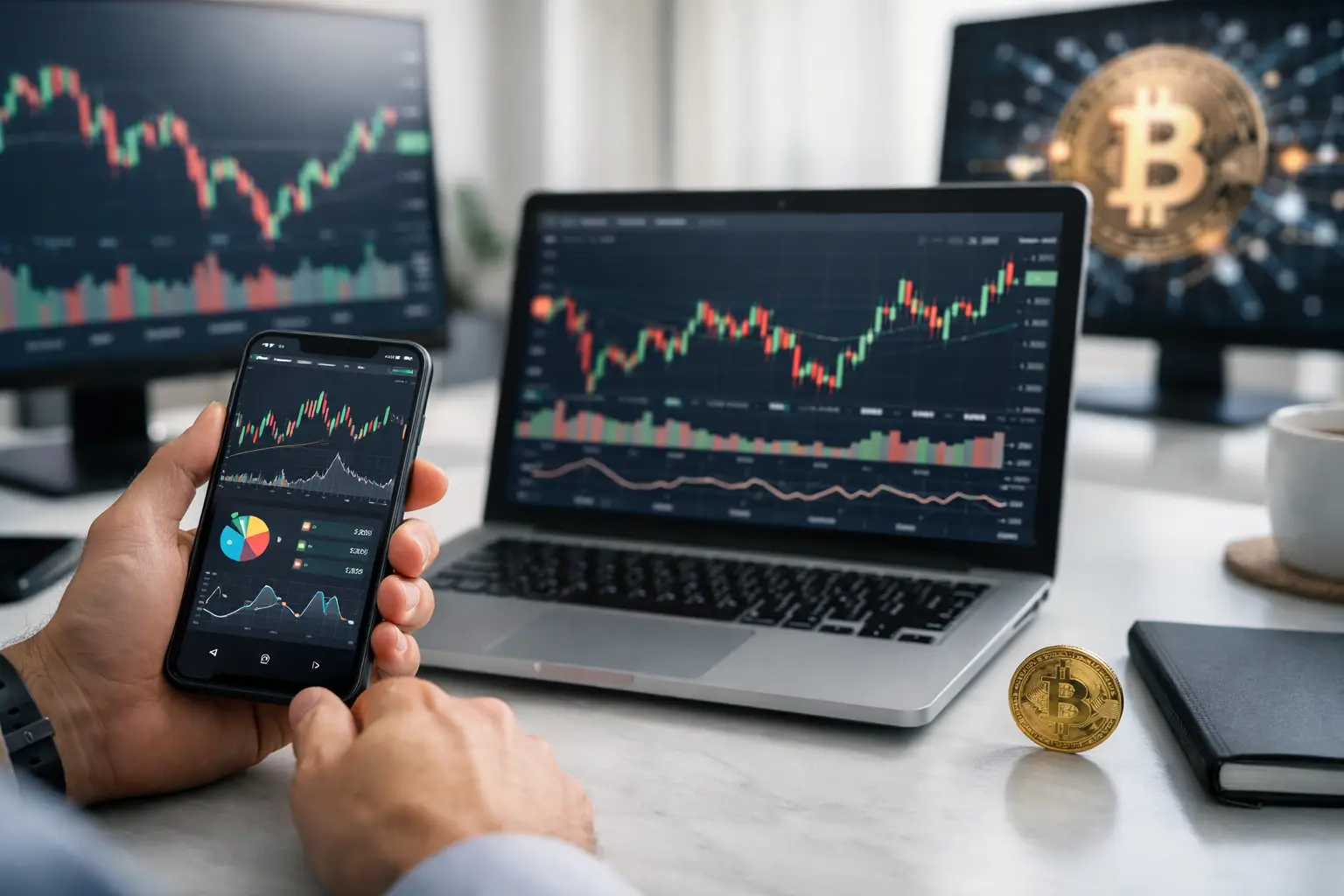
Most crypto losses do not come from missing the market. They come from reading it badly. A crypto trading analysis app is useful only if it reduces noise, aligns conflicting signals, and turns raw data into a decision you can act on with discipline.
\nThat standard is higher than most apps meet. Many platforms are excellent at showing charts, indicators, and social sentiment. Far fewer are good at answering the question traders actually care about: is this setup worth the risk right now?
\nFor a retail trader or self-directed investor, that difference matters. The problem is not access to information. Crypto markets already provide too much of it. The real problem is synthesis. When momentum looks strong on one timeframe, wave structure looks incomplete, and fundamentals remain mixed, the trader needs structure, not more tabs.
\nWhat a crypto trading analysis app should solve
\nA good app does not just collect market inputs. It organizes them into a usable framework. That means technical context, trend confirmation, risk definition, and timing should work together rather than compete for attention.
\nIf an app shows RSI, MACD, order book data, news flow, and a dozen overlays but leaves the user to reconcile everything manually, it is still a charting tool, not a decision tool. That distinction is easy to miss because many interfaces look advanced. In practice, advanced-looking dashboards often push the workload back onto the trader.
\nWhat serious users need is simpler and more demanding. They need to know whether multiple analytical pillars agree, whether the setup has acceptable risk, and where the trade becomes invalid. Without that, speed becomes a liability. You can enter faster, but not necessarily better.
\nThe best crypto trading analysis app is not a signal machine
\nThis is where expectations often go wrong. Many traders search for certainty and end up evaluating apps as if they should predict the next move with precision. That is the wrong benchmark.
\nThe best crypto trading analysis app is not the one that promises constant winners. It is the one that improves decision quality over time. That means helping traders avoid low-conviction entries, identify cleaner setups, and size risk with more consistency.
\nThere is a big difference between an app that says buy now and one that says this asset scores 78 out of 100, trend alignment is strong, structure is constructive, entry is valid in this zone, stop belongs here, and the current risk/reward is acceptable. The second approach is slower to market in appearance, but much more useful in real trading.
\nIt also respects uncertainty. Crypto is volatile, sentiment-driven, and often nonlinear. Any tool that removes nuance to sound confident usually creates risk elsewhere. A disciplined app should show when the evidence supports an opportunity, when the setup is neutral, and when risk is simply too high.
\nThe features that matter in real use
\nThe core feature is not more indicators. It is analytical convergence.
\nWhen technical analysis, trend filters, structural pattern recognition, and fundamental context point in the same direction, the user gets a clearer read. When those pillars disagree, the app should say so. That honesty matters more than cosmetic complexity.
\nScoring systems are especially useful when they are transparent enough to feel interpretable rather than arbitrary. A simple 0 to 100 score can work well because it compresses complexity into a signal the user can scan quickly. But the score alone is not enough. Traders need to see what is driving it. If momentum is strong but higher timeframe trend is weak, that should be visible. If the asset has a compelling chart but poor risk/reward from current levels, that should be visible too.
\nOperational levels are another non-negotiable. A crypto setup without entry, stop loss, and target is not really a setup. It is a market opinion. Many users do not need another opinion. They need a structured framework they can test, compare, and execute.
\nNarrative explanation also helps, if done carefully. A short AI-generated summary can save time by translating technical conditions into plain English. But it should explain the logic behind the rating, not replace it with vague language. Traders are right to distrust black-box outputs. If the app cannot show why a verdict exists, confidence drops fast.
\nFinally, verified performance matters. Not marketing screenshots. Not hand-picked wins. Publicly tracked outcomes across defined time windows are far more useful because they let users judge consistency, not storytelling.
\nWhere most apps fall short
\nThe most common failure is fragmentation. One tool handles charts, another handles screening, another tracks fundamentals, and a fourth provides sentiment. Traders end up building a workflow across multiple platforms and still have to make the final synthesis on their own.
\nThat may be acceptable for professionals with established processes. It is less efficient for retail users who want a fast second opinion before entering a trade. Time spent reconciling tools often leads to hesitation, late entries, or emotional overrides.
\nAnother issue is false precision. Some apps create an illusion of control with hyper-detailed data that is not actually decision-relevant. More decimals do not equal more clarity. In crypto, where volatility can invalidate a setup quickly, a clean view of trend, structure, and risk often beats a cluttered panel of tertiary metrics.
\nThen there is the problem of opacity. If a platform produces strong buy or strong sell labels without explaining the underlying methodology, the user is forced into trust without evidence. That rarely holds up through a losing streak.
\nWhat disciplined traders should look for
\nA useful app should help answer five practical questions.
\nFirst, is there a real opportunity here or just activity? Not every fast-moving coin deserves attention.
\nSecond, do the main analytical pillars align? A setup is stronger when classical technical analysis, trend behavior, and broader context support each other.
\nThird, where is the trade valid? Entry zones matter because buying a good asset at a poor level can still produce a bad trade.
\nFourth, where is the setup wrong? A stop loss is not just protection. It is part of the thesis.
\nFifth, is the expected reward worth the risk at current price? Many trades fail before entry because the distance to target no longer justifies the downside.
\nThese are straightforward questions, but answering them well takes structure. That is why a platform built around decision support tends to outperform one built around raw information density.
\nMontbon fits this model by combining technical analysis, automated Elliott Wave, multi-timeframe moving averages, and fundamental analysis into a single score and trade framework. The point is not to automate conviction blindly. It is to give traders a readable second opinion with clear classification, operational levels, and publicly checkable results.
\nWhy simplicity wins in crypto trading analysis
\nCrypto markets move fast, but speed should not force guesswork. The best tools simplify the decision without oversimplifying the market.
\nThat usually means an interface where a user can scan an asset, see whether it is classified as Opportunity, WATCH, or Risk, understand the score behind that verdict, and review the setup in under a minute. For active traders, that kind of compression is valuable because it preserves focus.
\nThere is a trade-off here. A highly simplified app may hide nuance. A highly detailed app may bury the conclusion. The best balance is a layered design: immediate verdict first, supporting detail second. That lets newer users act with more confidence while giving experienced traders enough context to validate the output.
\nThis matters even more in crypto because emotional decision-making is common. When markets are moving quickly, traders tend to chase strength, average into weak positions, or treat volatility as confirmation. A disciplined analysis app should interrupt that behavior by forcing the setup back into structure: score, trend, levels, and risk/reward.
\nChoosing the right crypto trading analysis app for your workflow
\nThe right choice depends on how you trade. A swing trader needs different support than a long-term allocator. A user screening multiple coins each day will value ranking and speed more than deep manual chart annotation.
\nStill, some standards are universal. The app should save time, not create more interpretation work. It should make methodology visible enough to build trust. It should define risk clearly. And it should help you reject weak trades as often as it helps you find good ones.
\nThat last point is underrated. A strong app does not just increase activity. It improves selectivity. In real trading, filtering out mediocre setups is often where performance gets cleaner.
\nIf a platform can give you a structured verdict, explain why it exists, show where the trade works and fails, and back its approach with transparent performance tracking, it is doing something far more useful than broadcasting noise. It is helping you trade with a plan.
\nThe market will always stay uncertain. Your process does not have to.
Tickers mentioned in this article
Open the technical analysis page for each ticker.
All covered tickers →Analyse any ticker with Montbon
Elliott Waves, multi-timeframe moving averages and a 0–100 score. Free to try.
Try Montbon for freeDisclaimer. Content for informational purposes only; not financial advice or a recommendation. Past performance is not a reliable indicator of future results. Montbon Analytics is not an authorised financial intermediary.
Montbon Weekly
Every Tuesday: the stocks that moved most in the week, with source and date. Measures, not predictions.
Send me Montbon Weekly: one email a week, in English, with the stocks that moved most. I can unsubscribe anytime. Privacy
💬 Discussion (0)
Sign in to join the discussion
Sign inMore articles
Reading the Tape: UBER, ABNB, and SHOP in Three Different Phases
A structured technical walkthrough of Uber, Airbnb, and Shopify using range position, momentum, and trend — purely for educational purposes.
Reading the Tape: Ferrari, Amazon, and Meta Through a Technical Lens
A structured look at how trend, range position, and momentum currently frame three widely-watched instruments — purely as an educational exercise.
Range Position, Momentum, and Trend: Reading Three Markets in August 2026
A structured technical walkthrough of Ferrari, Amazon, and Visa — what the data shows and how disciplined traders frame each situation.
Three Stocks, Three Stories: Reading Trend and Range in August 2026
Visa at a 3-month high, Broadcom near its low, UnitedHealth in between — here's how technical analysis frames each situation.