Manual Research vs AI for Smarter Trades
June 2, 2026
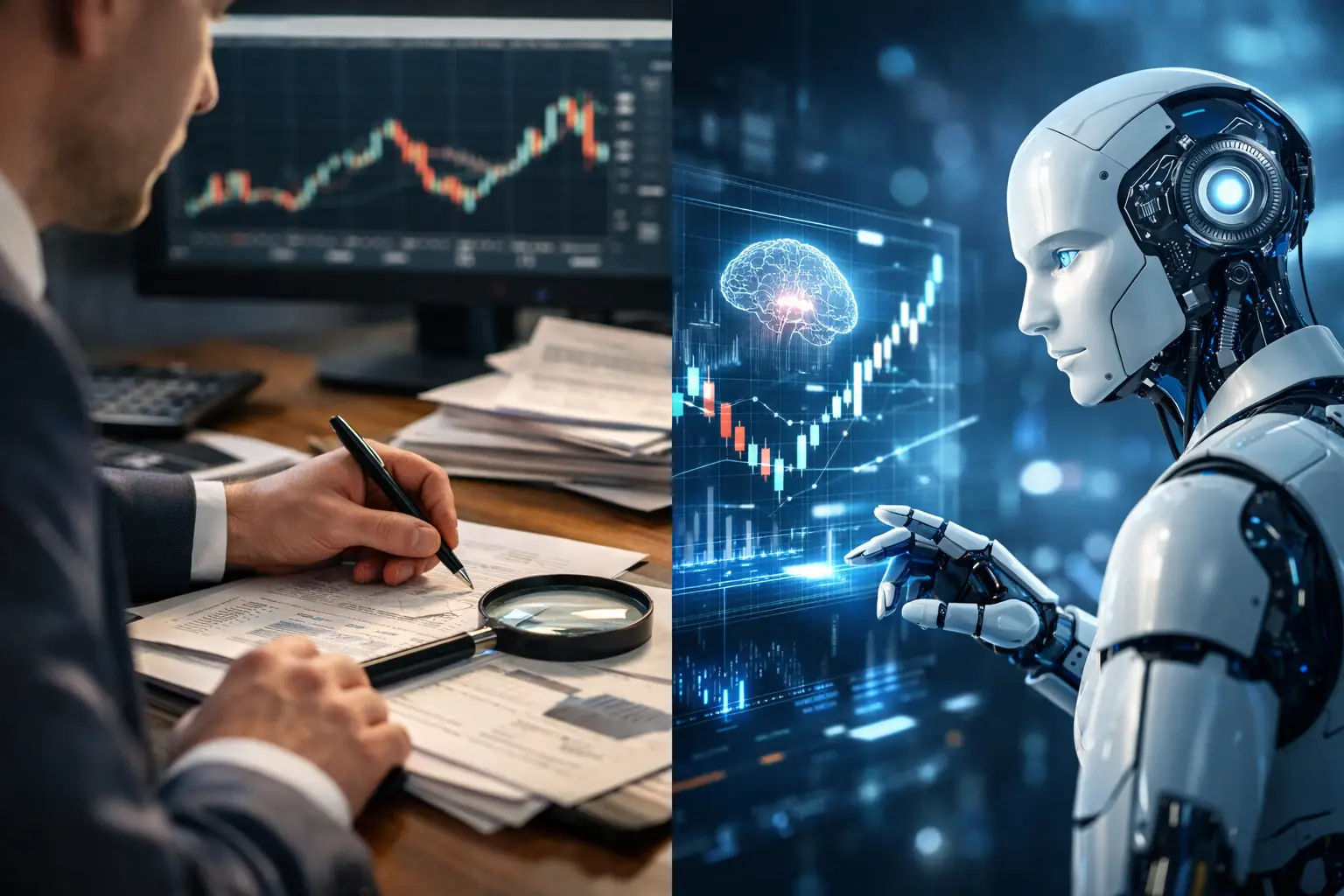
A trade idea can look solid at 9:30 a.m. and weak by lunch if your process depends on scattered tabs, selective memory, and a chart that suddenly means something different once price moves. That is where manual research vs AI becomes a real trading question, not a theoretical one. For most self-directed investors, the issue is not whether AI is replacing analysis. It is whether your process can stay consistent, fast, and testable under market pressure.
\nThe honest answer is simple: manual research still matters, but AI changes the economics of doing it well. If you are screening stocks, checking trend structure, reviewing fundamentals, and mapping risk on every candidate by hand, you can absolutely produce high-quality work. The trade-off is time, fatigue, and inconsistency. AI helps where repetition, scale, and structured comparison matter most. It helps less when the real challenge is judgment.
\nManual research vs AI: what actually changes
\nManual research is analyst-led. You choose the chart, the timeframe, the indicators, the earnings context, the news relevance, and the risk setup. Done well, it forces you to think clearly. You see the asset, not just the output. You understand why a setup exists, what could invalidate it, and which assumptions matter.
\nAI-led research compresses that workflow. It can score assets, compare multiple signals at once, summarize broad datasets, and surface candidates you would probably miss if you were reviewing charts one by one. In markets with thousands of possible instruments and constant movement, that speed matters.
\nBut speed is not the whole story. The real difference is process discipline. Manual work often becomes uneven because humans are uneven. We pay more attention to a stock we already like. We rationalize weak setups. We skip steps when the market is moving fast. AI, when built correctly, applies the same framework every time. That does not make it infallible. It makes it consistent.
\nFor active traders, consistency is usually more valuable than occasional brilliance.
\nWhere manual research still has an edge
\nThere is a reason serious traders still review charts and setups directly. Manual research gives you context that automated systems can flatten.
\nA price pattern may technically qualify as bullish while still looking unstable because the move is news-driven, extended, or building under obvious resistance. A fundamental snapshot may look acceptable until you notice that margins are compressing or that guidance quality has changed. A crypto chart may print momentum, but if liquidity is thin and volatility is erratic, the setup may not fit your risk tolerance even if the signal says go.
\nThis is where human analysis earns its place. It recognizes when the market is behaving in a way that does not fit the clean structure of a model. It catches narrative shifts early. It adjusts for regime change. It asks a useful question that many automated workflows still struggle with: does this signal make sense right now?
\nManual research is also stronger when your strategy is highly specialized. If you trade only a narrow universe, know the names deeply, and operate with a specific playbook, your edge may come from interpretation more than scale. In that case, AI can support the process, but it should not define it.
\nWhere AI clearly outperforms manual work
\nIf your problem is breadth, speed, or multi-factor alignment, AI has the advantage.
\nMost retail traders do not fail because they cannot read a chart. They fail because they cannot maintain a repeatable process across enough opportunities. Reviewing one setup carefully is easy. Reviewing fifty with the same depth is not. That is where manual workflows start to break.
\nAI is better at scanning large markets, applying the same logic to every asset, and turning complex signal stacks into a clear ranking. It can evaluate trend, momentum, structure, and fundamental inputs without losing focus after the tenth chart. It does not get impatient. It does not suddenly decide that rules matter less because a ticker is trending on social media.
\nThat is especially valuable when your method depends on multiple pillars lining up. A trader might want technical confirmation, broader trend alignment, and a minimum fundamental threshold before taking risk. Manually, that process is slow. With AI, it becomes operational.
\nThe key point is that AI is not useful because it sounds advanced. It is useful because it reduces friction between analysis and action.
\nThe real weakness of AI in market research
\nAI can be fast, structured, and impressive while still being wrong in a way that feels overly confident. That is the main risk.
\nA good interface can hide weak logic. A narrative explanation can make a mediocre setup sound precise. A score can create false certainty if you do not know what sits behind it. This is why black-box tools create hesitation among experienced traders. If the model gives a bullish signal but you cannot see whether that signal comes from trend strength, wave structure, moving averages, or noisy short-term data, trust becomes fragile.
\nIn manual research, at least you know how you got there. In AI-driven research, transparency matters as much as speed. If the system cannot show the components of the decision, it becomes harder to challenge, validate, or improve.
\nThat is also why raw AI text summaries are not enough. Traders do not need polished commentary alone. They need structured outputs they can test against price behavior. Score, setup quality, entry area, stop logic, and risk/reward matter more than generic language.
\nManual research vs AI is the wrong fight for most traders
\nThe practical question is not which side wins. It is which tasks should stay human and which should be systematized.
\nFor most self-directed investors, the best workflow is hybrid. Use AI to narrow the field, standardize the first pass, and highlight opportunities with strong signal convergence. Then use manual review to confirm whether the setup fits your strategy, timeframe, and risk profile.
\nThat approach fixes a common problem. Many traders either trust themselves too much or trust automation too much. The first group wastes time and becomes inconsistent. The second group outsources judgment. Neither is ideal.
\nA better model is structured delegation. Let the machine handle scale, repetition, and objective scoring. Keep final interpretation, position sizing, and trade acceptance with the human.
\nThat is not a compromise. It is usually the highest-quality process available to a retail trader.
\nHow to use AI without becoming dependent on it
\nStart by defining what you want AI to do. If the answer is “find me trades,” the workflow is too vague. If the answer is “screen for assets where technical structure, trend alignment, and fundamentals are all above my minimum threshold,” that is specific enough to be useful.
\nNext, separate idea generation from execution. AI is excellent at filtering and prioritizing. It is less reliable as a stand-alone execution authority. Before acting, check whether the setup still makes sense on the chart, whether volatility fits your rules, and whether the risk/reward is acceptable after the recent move.
\nThen watch for model comfort. This is when a clean score or confident explanation reduces your skepticism. Good traders stay slightly skeptical even when the setup looks organized. The goal is not to fight the model. The goal is to make sure clarity is supported by evidence.
\nIf a platform shows how its conclusion is built, that helps. A visible combination of technical, trend, and fundamental components is more useful than a single unexplained signal. One reason platforms like Montbon Analytics are gaining traction is that they turn multi-method analysis into a readable decision framework instead of asking users to trust an invisible engine.
\nWhat this means for smarter decision-making
\nIf you trade occasionally and follow a small watchlist, manual research may still be enough. If you scan many assets, work across stocks, ETFs, and crypto, or want a second opinion before acting, AI becomes less of a luxury and more of a control system.
\nThe advantage is not that AI makes markets easier. Markets stay noisy. The advantage is that AI can make your process cleaner. It can reduce missed signals, lower emotional drift, and show whether multiple pillars actually align before you put capital at risk.
\nThat matters because most bad trades do not come from a total lack of information. They come from fragmented information, inconsistent review, and decisions made too quickly or too late.
\nThe traders who benefit most from AI are not the ones looking for shortcuts. They are the ones who want a more disciplined way to validate what they are already trying to do.
\nIf your current process feels slow, subjective, or difficult to repeat, that is your signal. Keep the judgment. Systematize the noise. That is usually where better decisions start.
Tickers mentioned in this article
Open the technical analysis page for each ticker.
All covered tickers →Analyse any ticker with Montbon
Elliott Waves, multi-timeframe moving averages and a 0–100 score. Free to try.
Try Montbon for freeDisclaimer. Content for informational purposes only; not financial advice or a recommendation. Past performance is not a reliable indicator of future results. Montbon Analytics is not an authorised financial intermediary.
Montbon Weekly
Every Tuesday: the stocks that moved most in the week, with source and date. Measures, not predictions.
Send me Montbon Weekly: one email a week, in English, with the stocks that moved most. I can unsubscribe anytime. Privacy
💬 Discussion (0)
Sign in to join the discussion
Sign inMore articles
Reading the Tape: UBER, ABNB, and SHOP in Three Different Phases
A structured technical walkthrough of Uber, Airbnb, and Shopify using range position, momentum, and trend — purely for educational purposes.
Reading the Tape: Ferrari, Amazon, and Meta Through a Technical Lens
A structured look at how trend, range position, and momentum currently frame three widely-watched instruments — purely as an educational exercise.
Range Position, Momentum, and Trend: Reading Three Markets in August 2026
A structured technical walkthrough of Ferrari, Amazon, and Visa — what the data shows and how disciplined traders frame each situation.
Three Stocks, Three Stories: Reading Trend and Range in August 2026
Visa at a 3-month high, Broadcom near its low, UnitedHealth in between — here's how technical analysis frames each situation.