How to Use Elliott Wave Automatically
May 7, 2026
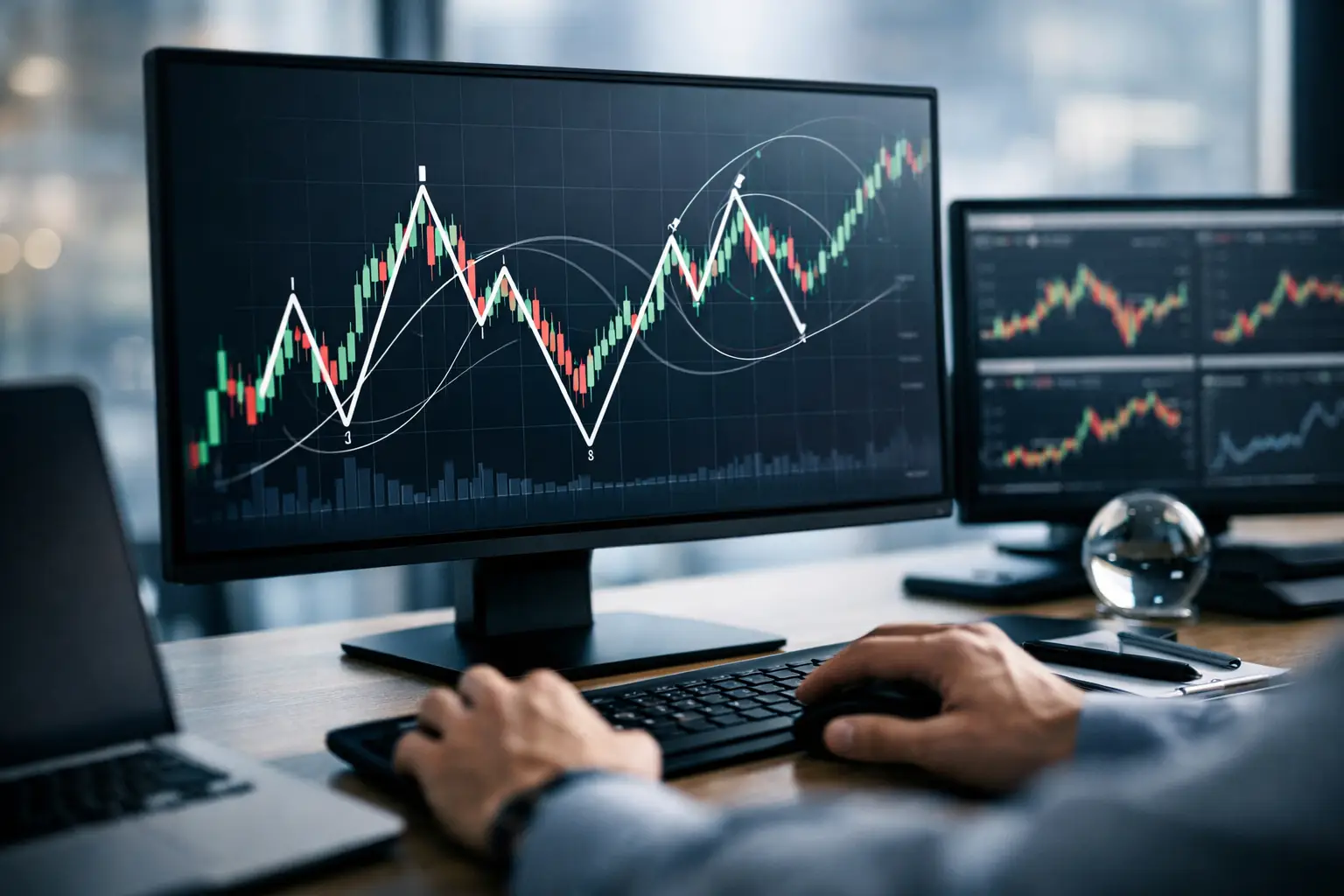
Most traders do not fail with Elliott Wave because the theory is useless. They fail because two people can label the same chart in two different ways and both sound convincing. If you want to know how to use Elliott Wave automatically, the real goal is not to replace judgment entirely. It is to reduce subjectivity, force consistency, and turn a flexible theory into something you can actually use inside a trading process.
\nThat distinction matters. Elliott Wave is powerful when it helps you frame market structure, trend phase, and likely continuation or correction. It becomes dangerous when you start bending the count to fit a bias. Automation helps because it applies the same logic every time, across many charts, without fatigue or emotion. But it only works well if you understand what an automated count can and cannot do.
\nWhat automatic Elliott Wave should actually solve
\nAn automatic Elliott Wave system should do three jobs well. First, it should identify plausible wave structures without forcing a pattern onto every chart. Second, it should rank those structures by quality or probability instead of pretending there is only one valid interpretation. Third, it should connect the count to a usable decision, such as trend continuation, correction risk, invalidation level, or trade timing.
\nThat is a more practical standard than asking whether the algorithm can \"predict the market.\" No wave model does that consistently in isolation. The value comes from structure. If an asset is likely in a third wave, that has different implications than a late fifth wave or an ABC correction. Automation turns that interpretation into a repeatable filter.
\nHow to use Elliott Wave automatically in a real workflow
\nThe best way to use automatic Elliott Wave is as one pillar of confirmation, not as a standalone trigger. Start with a chart or asset universe, run the wave model, and treat the output as a structural map. Then ask a simple question: does the current count align with trend, momentum, and risk/reward?
\nIf the automated count suggests an impulsive move is still developing, that may support a continuation setup. If it shows a completed five-wave advance into resistance, that may shift you toward caution, profit-taking, or waiting for a correction. The point is not to trade every count. The point is to make faster decisions with better structure behind them.
\nIn practice, that means using automated wave analysis in three stages. First, screen for assets where the count is clear enough to matter. Second, validate the count with at least one or two independent signals. Third, define execution levels from the chart rather than from the wave label alone.
\nWhy automation helps more than manual counting
\nManual Elliott Wave analysis has a familiar problem. It rewards expertise, but it also rewards imagination. A skilled analyst can produce excellent reads. The same analyst can also reinterpret the chart every time price moves against the position.
\nAutomation introduces discipline. It forces a model to follow fixed rules for swing detection, fractal structure, proportionality, and invalidation. It also allows consistent multi-timeframe analysis, which is essential because Elliott Wave without timeframe context is incomplete. A bullish lower-timeframe count inside a larger bearish correction is not the same setup as a bullish count aligned with the higher-timeframe trend.
\nThis is where many retail traders save time. Instead of manually counting waves on one chart for 20 minutes, you can review structured output across stocks, ETFs, and crypto in a fraction of the time. That speed matters, but the bigger advantage is consistency.
\nWhat an automated Elliott Wave system needs to be useful
\nNot all automation is equally helpful. A useful system needs clear swing identification, rule-based wave recognition, timeframe awareness, and some way to express confidence. If it only prints labels on a chart with no context, it will create more noise than clarity.
\nA better system tells you whether the current structure looks impulsive or corrective, where the likely invalidation sits, and how the wave interpretation fits with the broader trend. Even better, it combines that reading with other analytical pillars. That matters because wave theory is strongest when it is confirmed, not when it stands alone.
\nFor example, a bullish wave count becomes more actionable if moving averages support trend continuation and the broader technical context is not stretched. If fundamentals or market regime point the other way, the count may still be valid structurally but weaker as a trade.
\nThe trade-off: automation reduces subjectivity, not uncertainty
\nThis is the part many platforms skip. Automatic Elliott Wave does not remove ambiguity from markets. It removes some ambiguity from your process.
\nThere will still be alternate counts. There will still be failed fifth waves, extended third waves, truncated moves, and corrective patterns that stay messy longer than expected. A model can improve odds, but it cannot make wave structure simple on every chart. If a chart is chaotic, a disciplined system should say the structure is low quality rather than forcing confidence.
\nThat is a feature, not a weakness. One of the most useful outcomes of automation is knowing when not to act. If the count is unclear, the setup should not be promoted as high conviction.
\nHow to validate automatic wave counts
\nIf you are learning how to use Elliott Wave automatically, validation is where the process becomes practical. Start by checking whether the wave count aligns with trend direction on the higher timeframe. Then look at momentum and moving average structure. A bullish count with weak trend confirmation deserves more caution than a bullish count supported by both price structure and trend filters.
\nNext, check price location. Elliott Wave is not just about shape. It matters whether the structure is forming near support, resistance, prior breakout zones, or exhaustion levels. An automated count that ignores context may be technically interesting but operationally weak.
\nFinally, define the invalidation level before you consider entry. This is one of the biggest advantages of wave-based trading when done correctly. A good count gives you a point where the interpretation is likely wrong. That makes risk easier to structure.
\nUsing automatic Elliott Wave for entries and exits
\nAutomation is most useful when it improves timing without pretending to micromanage every tick. If the model identifies a likely corrective pullback within a broader impulsive trend, you may use that to wait for a better entry instead of chasing strength. If it flags a mature five-wave move, you may tighten stops or reduce position size.
\nEntries should still come from a complete setup. That means a favorable wave context, acceptable risk/reward, and price levels you can actually execute. Exits can also improve with wave structure. For instance, if a projected impulse looks extended and momentum begins to fade, that can support a more conservative target or active stop management.
\nThis is where a structured platform helps. Rather than giving you theory alone, it can translate the wave read into an operational view with score, setup classification, and price levels. That is much closer to how traders actually make decisions.
\nCommon mistakes when using Elliott Wave automatically
\nThe first mistake is treating the count as a signal by itself. Wave structure is context, not certainty. The second is trusting every labeled chart equally. Some structures are clean. Others are borderline. Your process should reflect that difference.
\nThe third mistake is ignoring multi-pillar confirmation. If the wave count says bullish but trend, momentum, and broader market conditions disagree, the setup deserves lower confidence. The fourth mistake is constantly switching between alternate counts after the trade is live. Automation should reduce that behavior, not justify it.
\nA more disciplined approach is to choose the highest-quality interpretation, define the invalidation level, and accept that being wrong is part of the process. Good analysis is not about avoiding all losses. It is about making cleaner decisions with known risk.
\nWhere automatic Elliott Wave fits best
\nAutomatic Elliott Wave tends to work best for swing trading, positional setups, and market scanning across many assets. It is less useful if you expect it to act like a fast scalping signal generator. Wave structure needs enough price development to become meaningful.
\nIt is also especially useful for traders who want a second opinion. If you already have a directional view, an automated wave read can help you test whether the structure supports it or warns against it. That is one reason platforms like Montbon combine automated Elliott Wave with technical, trend, and fundamental layers instead of presenting it as a black box.
\nIf you want better results, think of automatic Elliott Wave as a way to organize market structure and reduce interpretive noise. The edge is not in having more labels on a chart. The edge is in having fewer unclear decisions.
\nThe best use of automation is simple: let the system do the repetitive structural work, then use that clarity to trade only when the picture is aligned enough to deserve your risk.
Tickers mentioned in this article
Open the technical analysis page for each ticker.
All covered tickers →Analyse any ticker with Montbon
Elliott Waves, multi-timeframe moving averages and a 0–100 score. Free to try.
Try Montbon for freeDisclaimer. Content for informational purposes only; not financial advice or a recommendation. Past performance is not a reliable indicator of future results. Montbon Analytics is not an authorised financial intermediary.
Montbon Weekly
Every Tuesday: the stocks that moved most in the week, with source and date. Measures, not predictions.
Send me Montbon Weekly: one email a week, in English, with the stocks that moved most. I can unsubscribe anytime. Privacy
💬 Discussion (0)
Sign in to join the discussion
Sign inMore articles
Reading the Tape: UBER, ABNB, and SHOP in Three Different Phases
A structured technical walkthrough of Uber, Airbnb, and Shopify using range position, momentum, and trend — purely for educational purposes.
Reading the Tape: Ferrari, Amazon, and Meta Through a Technical Lens
A structured look at how trend, range position, and momentum currently frame three widely-watched instruments — purely as an educational exercise.
Range Position, Momentum, and Trend: Reading Three Markets in August 2026
A structured technical walkthrough of Ferrari, Amazon, and Visa — what the data shows and how disciplined traders frame each situation.
Three Stocks, Three Stories: Reading Trend and Range in August 2026
Visa at a 3-month high, Broadcom near its low, UnitedHealth in between — here's how technical analysis frames each situation.